

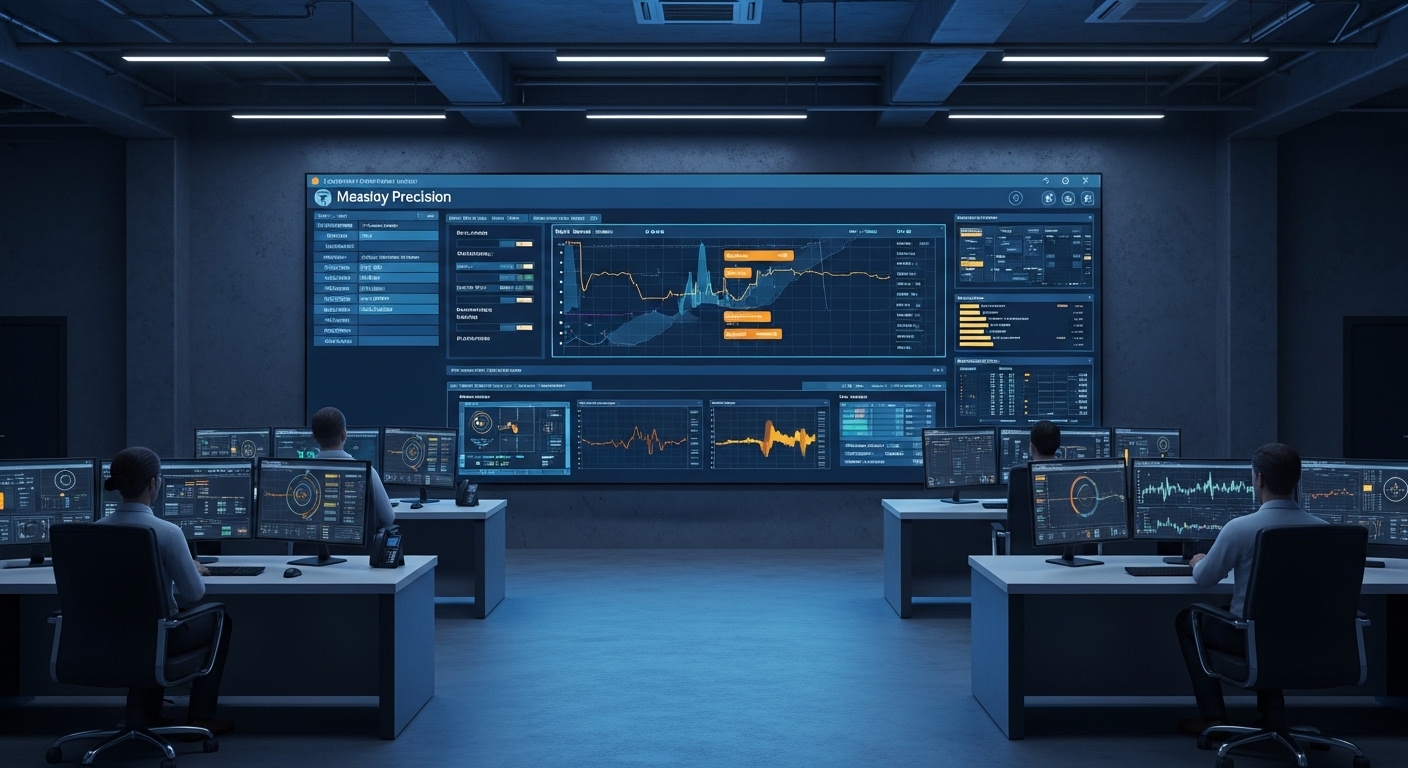
Imagine a fortress with no visible walls — a structure built not from stone, but from code.
Its corridors are silent, yet alive with motion. Its guardians do not carry shields; they wield dashboards. This is the modern cybersecurity control room — the unseen perimeter protecting industrial operations, critical infrastructure, and digital ecosystems from threats that travel at the speed of light.
In a world where control rooms orchestrate oil refineries, smart cities, energy grids, and transportation networks, the greatest danger is no longer mechanical failure — it is intrusion. A single malicious packet, a compromised credential, a silent vulnerability buried deep in firmware — these are the new fault lines of industry.
Inside the cybersecurity command center, screens glow not with production metrics, but with behavior patterns. Network traffic ebbs and flows like tides. Most of it is routine — predictable, rhythmic. But sometimes, there’s a ripple. A login attempt at an unusual hour. A data request that doesn’t match historical behavior. A device communicating with an unfamiliar endpoint.
It doesn’t look like chaos. It looks like subtlety.
And that’s the art of cyber defense.
Security analysts don’t wait for alarms to scream. They listen for anomalies — whispers in encrypted tunnels. A deviation in packet frequency. A microsecond delay in system response. A privileged account accessing layers it rarely touches. These are not errors; they are signals.
In industrial environments, the stakes are higher. A cyberattack here doesn’t just corrupt files — it can halt production lines, manipulate sensor data, disrupt energy supply, or compromise safety systems. The digital and physical worlds are no longer separate. They are intertwined — and so must be their protection.
This is where layered security becomes architecture.
Firewalls stand like outer walls. Intrusion Detection Systems act as watchtowers scanning the horizon. Endpoint protection fortifies individual devices. Network segmentation creates internal compartments, preventing a breach from spreading like wildfire. And at the center, a Security Operations Center (SOC) integrates intelligence, analytics, and human judgment into one unified command.
But technology alone is not the shield.
Artificial intelligence may flag suspicious patterns, but it is human expertise that interprets intent. An algorithm might classify activity as “low risk.” An experienced analyst senses context — correlates it with geopolitical events, vendor updates, or past incidents. They dig deeper. They isolate. They neutralize.
Threat contained.
Business uninterrupted.
The masterpiece of cybersecurity is not visible victory — it is invisible resilience. Systems continue operating. Data flows securely. Operators in the main control room focus on production, unaware that a silent battle was fought and won behind the scenes.
True security is continuity.
For organizations managing mission-critical control rooms, cybersecurity is not an add-on. It is foundational. It must be designed into the infrastructure — from secure network topology to real-time monitoring, from encrypted communication protocols to disaster recovery strategies.
Because in today’s connected industrial landscape, protection is not reactive.
It is predictive.
It is proactive.
It is perpetual.
The cybersecurity control room is not merely a monitoring hub — it is a guardian of trust. A digital sentinel ensuring that operations remain stable, safe, and sovereign.
The world may never see the attacks that were prevented.
And that is precisely the point.